

Hilo by Spribe is a compact card-prediction game built around a simple question: will the next card be higher or lower than the one currently shown? Its rules are easy to grasp, but each prediction changes the risk and potential return. That combination makes Hilo appealing to players who prefer quick rounds, clear choices, and a game they can follow without learning a long list of special features.
This review looks at how Hilo works, what influences its payouts, and how to approach a session with sensible limits. Availability, rules, and betting limits can vary by casino and location, so check the game information and local requirements before playing. Hilo is a game of chance; tips can help structure decisions, but they cannot guarantee a win.
How Hilo Works
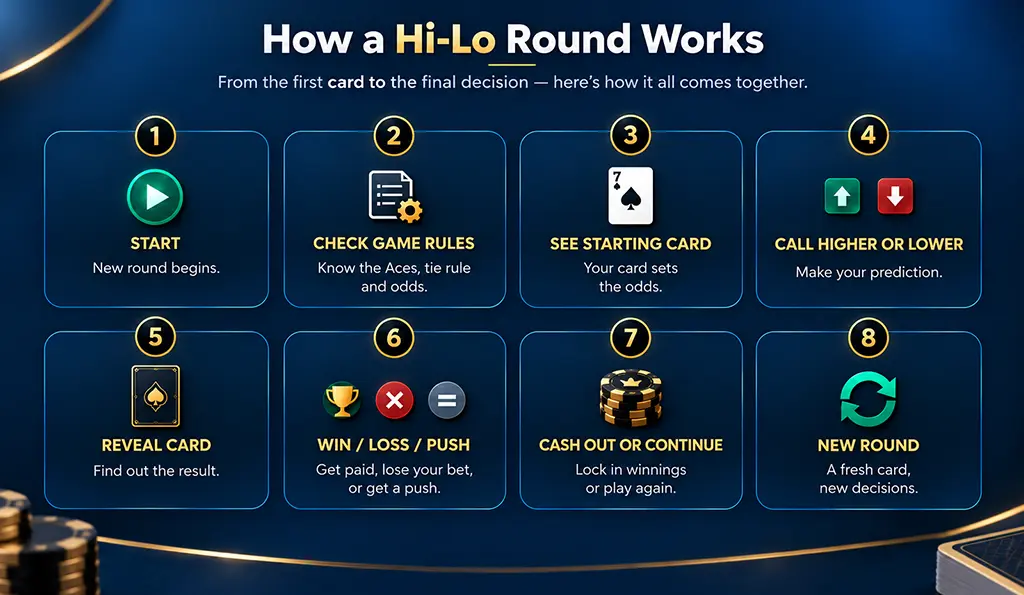
A round begins with a face-up card. The player predicts whether the next card will be higher or lower. If the prediction is correct, the game typically offers a choice to continue and make another prediction or to collect the current payout. A wrong guess ends the round and may forfeit the active wager or accumulated return, according to the rules displayed by the casino.
Some versions may also let players predict that the next card will be the same rank. Whether this choice is available, and how it is priced, depends on the game configuration. Before betting, open the help or paytable panel and confirm the available options, card values, treatment of aces, and any special rules.
Cards, choices, and multipliers
The visible card affects the next decision. A middle-ranking card generally leaves more cards above and below it, while a very high or low card can make one direction appear more attractive. However, the deck’s composition, the game’s dealing rules, and the exact payout schedule matter. A prediction that feels obvious is not necessarily a profitable one: the payout should be considered alongside the chance of being correct.
As a player continues through a round, the possible return may rise. So does the chance of eventually losing the round. The central decision is therefore not only “higher or lower?” but also “is the current return worth protecting, or is another prediction worth the added risk?” Collecting ends the round and locks in the displayed amount, subject to the casino’s rules.
Gameplay Tips for a More Controlled Session
Set a budget and a stopping point
Choose a session budget before opening the game, and treat it as the maximum amount you are willing to spend—not as money that must be recovered. Decide in advance how long to play or what loss limit will end the session. If you reach either limit, stop rather than increasing stakes in an attempt to get back to even.
It can also help to choose a modest target for a session. A target is not a promise of profit; it is simply a cue to pause when you have reached a result you are comfortable leaving with. Hilo’s short rounds make it easy to continue playing without noticing how quickly decisions accumulate, so scheduled breaks can be useful.
Think about collecting before the round starts
Decide what kind of session you want. A cautious approach might involve collecting after a small number of successful predictions, while a higher-variance approach may continue further in pursuit of a larger multiplier. Neither approach changes the underlying odds, and neither is universally best. The important point is to make the decision deliberately rather than reacting to the excitement of a growing payout.
Do not assume a streak makes the next prediction “due” to succeed, or that a previous loss makes a win more likely. Each decision should be based on the information and rules relevant to that prediction. Past outcomes do not provide a dependable forecast of future cards.
Use small stakes while learning
If you are new to Hilo, begin with low stakes or use a free-play option if the casino offers one. This gives you time to understand the interface, how the payout changes, and when the collect option appears. Check the displayed amount carefully: the current return may include the original stake, winnings, or both, depending on how the casino presents it.
Keep an eye on the total wagered across the session, not just the outcome of the latest round. A series of small bets can add up. Avoid playing when distracted, stressed, or under the influence of alcohol or other substances, since those conditions can make it harder to follow limits.
Odds and Payouts: What to Check
Hilo’s outcome depends on the card rules and the specific game configuration. The visible rank offers useful context, but it does not make a prediction certain. To evaluate a choice, compare its displayed payout with the probability implied by the rules. A higher potential multiplier often accompanies a less likely outcome; a more likely choice may offer a smaller return.
Do not rely on a generic odds chart unless it matches the exact version you are playing. The game’s help screen is the best place to confirm card values, whether suits matter, how ties are handled, and what happens at the top and bottom of the card range. If the casino lists a return-to-player figure or other theoretical statistic, remember that it describes long-run expectations across many plays, not the result of an individual session.
A simple way to compare choices
Before selecting higher or lower, consider three questions:
- How many possible next cards would make this prediction correct under the stated rules?
- What return does the game offer for the choice?
- Would you be comfortable losing the current stake or accumulated round return if the prediction fails?
This is a practical comparison, not a guarantee of an advantage. The casino’s paytable determines how potential returns relate to the game’s probabilities, and a player cannot remove the house edge through a betting pattern.
Playing Hilo at an Online Casino
Hilo by Spribe may be available through casino websites and, where supported, mobile interfaces. The game’s minimal layout can work well on a smaller screen: the current card, prediction buttons, stake controls, and collect option are usually the key elements. Interface details can differ, so take a moment to locate the rules and account controls before beginning.
Check that the casino is legally available to you and that its operator is appropriately licensed for your jurisdiction. Review deposit, withdrawal, identity-check, and bonus terms before making a payment. A bonus may come with wagering requirements, game restrictions, expiry dates, or other conditions; read them rather than assuming the advertised amount is immediately withdrawable.
Choose a secure connection, use a strong password, and enable account security features where offered. Never share login details, and contact the casino through its official support channels if you have an account or payment concern. Avoid third-party downloads or links that cannot be verified as belonging to the operator.
Responsible Play and Player Protection
Hilo is gambling, not a way to earn income. Set limits on deposits, losses, and session time if the casino provides those tools. Take breaks, and do not borrow money or use funds needed for rent, bills, food, or other essentials. If playing stops being enjoyable or becomes difficult to control, stop and seek support from a trusted person or a gambling-help service in your region.
Look for self-exclusion options at casinos with quick titles if you need to block access to gambling for a period or longer. Self-exclusion tools and their duration vary by operator and jurisdiction, so check the relevant terms and confirm what accounts or services the restriction covers. Depending on where you live, national or regional self-exclusion programs may also be available.
Questions and Answers
Can a strategy guarantee a win in Hilo?
No. A strategy can help you set limits and make choices consistently, but it cannot control the cards or guarantee a positive result. Treat each wager as money you could lose.
Is it better to choose higher or lower?
There is no universal choice that is always better. The visible card and the game’s rules affect the likelihood of each direction, while the payout affects the potential return. Check the paytable and decide whether the risk is acceptable to you.
Should I continue after a successful prediction?
That depends on your risk preference and the amount currently available to collect. Continuing may increase the potential payout, but it also puts the round’s return at risk. Decide on a stopping rule before you start, and follow it.
Does Hilo use a live dealer?
Hilo is generally presented as an automated card game rather than a live-dealer table game. The exact presentation and technical details can depend on the casino and version. Refer to the game information available in the lobby.
Can I play on a phone?
Many online casinos offer browser-based mobile play, though device and browser support can vary. Visit the casino’s official website, check compatibility, and avoid installing an app from an unverified source.
Final Verdict
Hilo by Spribe offers straightforward rules, quick rounds, and an ongoing choice between taking a displayed return and risking it for a larger one. Its appeal lies in that simple tension rather than in complex features. The best way to approach the game is to learn the specific rules, use stakes you can afford to lose, and set clear limits before playing.
For players who enjoy brief, decision-based casino games, Hilo can be an engaging option when offered by a reputable and legally accessible operator. It is not a dependable source of income, and no progression system or prediction method can eliminate chance. Play only for entertainment, and stop when your limits tell you to stop.